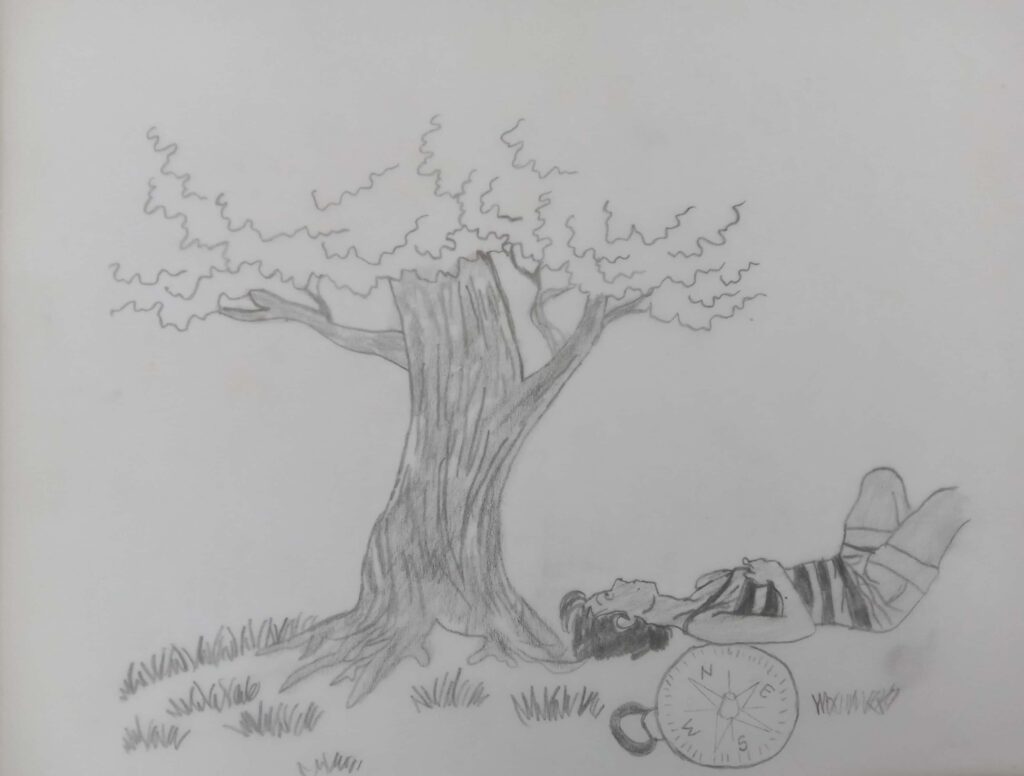
Juillet 1999 : à Wari-Mao au centre du Bénin. Comme à l’accoutumé à la FSA, les étudiants en fin de formation doivent effectuer un stage pour l’obtention du Diplôme d’Ingénieur Agronome. Après maintes réflexions, je me retrouve avec mon compagnon Prof. Teka Oscar comme étudiants du Prof. Sinsin. Le collègue Oscar avait pris l’option de faire de la phytosociologie et gestion des parcours naturels, moi par entêtement, et malgré l’instance de notre encadreur de renoncer au sujet, je suis resté fidèle à mon ambition d’aborder les champignons comestibles. Faire les parcours naturels était pour moi un expert de plus sur la kirielle qu’il y avait déjà. En effet, avant mon compère Oscar, il y avait les tous premiers comme Prof. Oumorou, Prof. Houinato et Dr. Bako, s’en ont suivi d’autres comme Prof. Natta, Prof. Kindomihou et j’en passe… Cette pléthore de phytosociologues dénote déjà d’une forte concurrence imminente dans leur rang, il fallait sortir des sentiers battus, comme aimait si bien le dire un de nos enseignants. La spécificité et la délicatesse de mon thème me conduisit non pas à Samiondji, ni même à L’Okpara ou même Bétécoucou, qui étaient devenus les fermes d’immersion et de stage des spécialistes des parcours naturels, mais plutôt à Wari-Maro. En son temps, le massif forestier de Wari-Maro était l’un des mieux préservés au Bénin. Et Wari-Maro, un petit village alors peuplé de 200 habitants au plus, gît aux confins de la forêt. Ici, la belle forêt contraste avec une série d’inselbergs orientés Nord-Sud. Au loin vers le sud, le massif fait corps avec la forêt des Monts Kouffè. A Wari-Maro, la belle forêt commence aussitôt les cases franchies. On y découvre un vaste étendu de forêts claires faits d’arbres aux branchages plutôt étalés, couvrant un sous-bois léger dans lequel un éléphant peut faire banalement 40 km/heure. Ainsi donc, par un après-midi du mois de Juillet 1999, je reçu donc mes encadreurs, qui, à la faveur d’une mission du projet Flore du Bénin, ont fait un crochet à Wari-Maro pour s’acquérir de l’avancement de mes travaux de terrain. L’équipe est constituée du Prof. Sinsin (mon encadreur), feu Prof. Sokpon (RIP), Dr. Agbani et d’un jeune chercheur du projet « Flore du Bénin » en la personne de Charlemagne. Je revenais d’une visite de mes placeaux quand l’équipe débarqua devant moi. Mes paniers pleins de champignons déposés, je repris le chemin de la forêt avec mes visiteurs encadreurs. Au menu, une randonnée botanique le long de l’inselberg Soubakpérou pour fouiller les végétations éphémères. Soubakpérou, avec ses 620 m d’altitude, est l’une des attractions de la région. J’aimais bien faire cette randonnée, chaque fois qu’une équipe se présentait, et en son temps, il m’arrivait de faire cette colline 3 fois dans la même journée. En file indienne avec à sa tête le guide Salomon et Charlemagne devant moi, nous entamions la piste qui prend départ du village pour rejoindre la colline emblématique de la région. Quelques fouilles au piémont autour de la colline et nous commencions la montée. Après deux heures, nous voilà donc au sommet. Un décompte fait, on remarque l’absence de Charlemagne. Mais alors, où est passé Charlemagne ? Personne ne pouvait répondre. Au début, on pensa à un retard et qu’il allait nous rejoindre, hélas, 1h de fouille et 30 mn de pause, il n’est toujours pas venu. On a compris alors qu’il nous attend certainement au piémont. Il était presque 16h00, il fallait entamer la descente pour être sûr de rentrer au village avant la nuit. Revenu au piémont, Charlemagne ne s’y trouve. Au village non plus. On se plongea donc dans des inquiétudes. De spéculations en spéculations, j’émis l’avis que certainement il avait faim et qu’il s’était écroulé sous un arbre. Prof. Sinsin s’exclama de suite : « Mais, nous avons mangé avant de partir ». Oui, en effet on avait mangé, mais je me rappelle bien que c’était deux baguettes de 125 fcfa divisées en 8 tranches, chacun ayant reçu une tranche. On avait en effet bien mangé…Il n’était pas encore totalement sombre, ensemble avec les villageois qui nous servaient de pisteurs et de lampes torches, on décida de retourner à la recherche. On le retrouva vers 23h allongé sous un arbre mais très loin et du côté sud de la colline. Le lendemain, on lui demanda de narrer comment cela s’est passé. En fait, au piémont déjà il était fatigué, il s’est séparé du groupe et a voulu trainer en attendant notre retour. Entre temps, et puisqu’on ne revenait pas, il a voulu retourner seul au village. Malheureusement il a aussi perdu la piste. Wari-Maro est située au nord de la Colline, alors il a voulu se servir de la boussole pour retrouver le nord. Ironie du sort, quand les dieux des inselbergs décident de jouer de sales tours aux chercheurs : les inselbergs riches en fer ont déstabilisé la boussole, l’aiguille dansait dans tous les sens. Charlemagne s’avançait davantage vers le sud pensant qu’il se dirigeait vers le nord. Epuisé, il s’écroula sous un vieux néré avec l’espoir qu’il sera retrouvé. D’Abomey-Calavi, c’était votre dévoué Prof. NS YOROU
July 1999: Wari-Mao, central Benin. As usual at the Faculty of agronomic Sciences, students at the end of their training have to do an internship to obtain their Diploma in Agricultural Engineering. After much reflection, I found myself with my companion Prof. Teka Oscar as Prof. Sinsin’s students. My colleague Oscar had opted for phytosociology and rangeland management, while I remained stubbornly faithful to my ambition to study edible fungi, despite our supervisor’s urging me to abandon the subject. For me, working on rangelands was just one more expert on the long list that already existed. Indeed, before my colleague Oscar, there were the very first phytosociologists like Prof. Oumorou, Prof. Houinato and Dr. Bako, followed by others like Prof. Natta, Prof. Kindomihou and so on. This plethora of phytosociologists was already a sign of impending competition in their ranks, and we had to think outside the box, as one of our teachers was fond of saying. The specificity and delicacy of my theme led me not to Samiondji, nor even to Okpara or Bétécoucou, which had become the immersion and training farms for phytosociologists, but rather to Wari-Maro. At this time, the Wari-Maro forest reserve was one of the best preserved in Benin. And Wari-Maro, a small village of no more than 200 inhabitants at the time, lies at the very edge of the forest. Here, the beautiful forest contrasts with a series of inselbergs running north-south. Southward, the reserve forms a continuum with the Monts Kouffè forest. At Wari-Maro, the beautiful forest begins as soon as you cross the huts. It’s a vast expanse of open woodland, made up of trees with spreading branches, covering a light undergrowth in which an elephant can run at an average of 40 km/hour. So, one afternoon in July 1999, I received my supervisors, who, thanks to a mission for the Flore du Bénin project, had made a detour to Wari-Maro to check on the progress of my fieldwork. The team consisted of Prof. Sinsin (my supervisor), the late Prof. Sokpon (RIP), Dr. Agbani and a young researcher from the “Flore du Bénin” project, Charlemagne. I was returning from a visit to my plots when the team arrived ahead of me. With my baskets full of mushrooms in hand, I headed back into the forest with my visitor-framers. On the menu: a botanical hike along the Soubakpérou inselberg to explore the ephemeral vegetation. Soubakpérou, with its 620 m altitude, is one of the region’s attractions. I used to love doing this hike, whenever a team came along, and in its time, I sometimes did this hill 3 times in one day. In single file, with guide Salomon at the head and Charlemagne in front of me, we set off along the trail from the village towards the region’s emblematic hill. A few digs in the foothills around the hill and we were off. After two hours, we reached the summit. Counting down, we noticed that Charlemagne was missing. But then, where had Charlemagne gone? No one could answer. At first, we thought he was late and would be joining us, after an hour of searching and a 30-minute break, he still hadn’t shown up. We then realized that he was probably waiting for us at the foothills. It was almost 4pm, and we had to start descending to make sure we got back to the village before dark. Back at the piedmont, Charlemagne was nowhere to be seen. Nor was he in the village. We began to worry. From speculation to speculation, I suggested that he was certainly hungry and had collapsed under a tree. Prof. Sinsin immediately exclaimed: “But we ate before we left. Yes, we did eat, but I remember it was two 125 fcfa baguettes divided into 8 slices, with each of us getting a slice. We had indeed eaten… It wasn’t totally dark yet, so together with the villagers who acted as trackers and flashlights, we decided to return to the search. At around 11pm, we found him lying under a tree, far away and on the south side of the hill. The next day, we asked him to tell us how it had happened. In fact, by the time we reached the foothills, he was already tired, so he got separated from the group and wanted to hang around until we got back. In the meantime, since we weren’t coming back, he decided to return to the village on his own. Unfortunately, he also lost the trail. Wari-Maro lies to the north of the Hill, so he decided to use the compass to find his way back. Ironically, when the inselberg gods decided to play dirty tricks on the scientists, the iron-rich inselbergs destabilized the compass, causing the needle to dance all over the place. Charlemagne moved further south, thinking he was heading north. Exhausted, he collapsed under an old Néré tree in the hope of being found. From Abomey-Calavi, your devoted NYS